

Market shifts and adaptability
National sales manager, Jocelyn Munsami, takes up the story: ‘Unprecedented demand for hand sanitisers saw the emergence of new brands, as well as established brands extending their ranges to include sanitisers and disinfectants. The initial high demand for these products resulted in major market shortages; and product manufacturers, together with their supply chains, were under immense pressure.’ Clomark has been part of the solution in meeting this unprecedented demand, Jocelyn notes. ‘Thanks to our internal design capabilities, we’re able to assist customers from initial design concept to final product, and our customers appreciate the support we provide,’ she says. In Shyam Chirkoot’s view, this illustrates the advantages of not remaining fixated on manufacturing products no longer in demand. Shyam also recommends tuning in to international business experiences to find inspiration on navigating challenges, and pre-empting market movements over the next year or two. He cites automotive sales, which have taken a nosedive in Europe, as an example of what South Africa can expect in the near future. ‘Businesses need to focus on leapfrogging their technological capabilities into markets growth,’ he asserts. ‘For example, injection moulding operations are expanding into the manufacture of essential healthcare items such as face shields, and even stimulating demand for new products.’ Clomark has followed this approach, utilising its automotive technology to develop disposable plastic aprons for the healthcare sector, and has offered these products to government, largely as a solidarity gesture.

Business reengineering
during lockdown
Clomark is one of many South African companies that had to adapt fast to pandemic-related circumstances.
The company’s executives reflect on ways in which business leaders have faced the ultimate test: their very survival.
WITH scant warning and insufficient time to prepare, drastic transformation came about with government’s swift announcement of the initial lockdown.
It caused pandemonium in the business world and many business owners faced transitional challenges.
‘We had to close down our automotive division during the initial lockdown,’ relates Clomark MD, Shyam Chirkoot. ‘But then printed packaging for essential items became an area of high demand.
It took some eleventh-hour negotiations to secure all the necessary materials, as some suppliers had initially opted to close.
We had to be forthright in our communication with these suppliers, persuading them to remain open and support government’s assurances that food and other essential items would remain readily available during the lockdown.
We then set about responding to a whole new environment.’ While government is making available the stimulus package of R500-billion, it’s still unclear as to which businesses will qualify for relief. This means that leaders cannot afford to wait for a bail out – their immediate need to innovate is crucial for sustainability.
On today’s new playing field, business leaders need to remain focused, optimistic and frugal. ‘New norms are quickly replacing those of the recent past, and they may well present new opportunities!’ Shyam remarks. ‘However, not all is doom and gloom,’ he continues. ‘While the lockdown has been disastrous for many industries, it has provided opportunities for others.
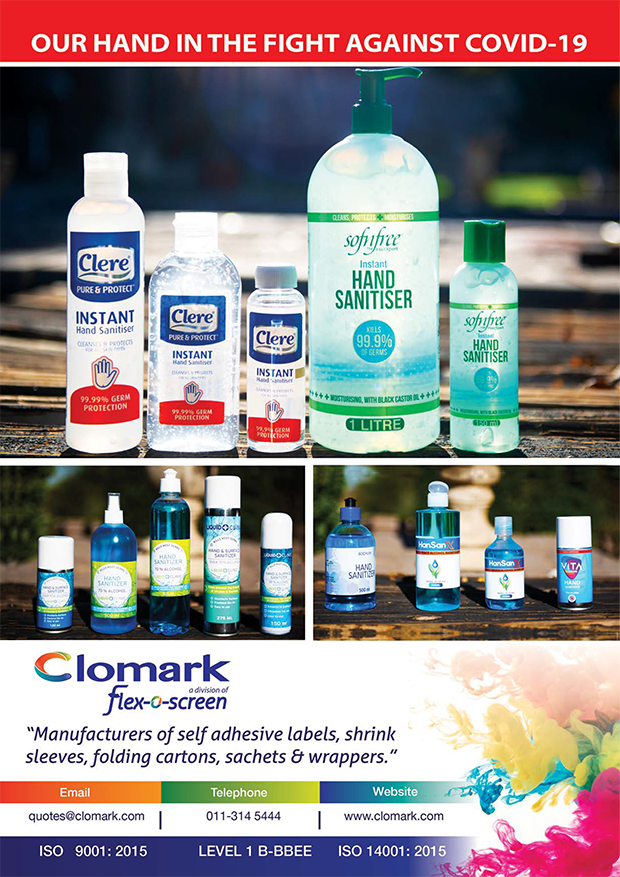
Over the past few weeks, we’ve turned to the manufacture of printed packaging (self-adhesive labels, shrink-sleeves, printed cartons, etc) for food and hygiene products.

Risk mitigation strategies
BUSINESSES in essential services, well aware of health risks, have had to think on their feet in terms of implementing best hygiene practices, to keep employees feeling safe and valued. Clomark, for instance, provides transport and accommodation for key employees who are at high risk of coronavirus exposure. Additionally, says operations director, Dhiraj Chirkoot, the company maintains regular telephonic contact with employees at home, keeping them motivated and appreciated. Dhiraj also points out that as the lockdown is eased, companies need to consider employee and business risks, and implement robust risk mitigation procedures. ‘Our operations team has seen stringent risk management procedures being developed particularly well by automotive assembly plants, and has adopted many good practices into our own risk mitigation practices,’ he adds. Where possible, Clomark is keeping as many workers employed as possible, with a reduction in working hours, as well as staff rotation. ‘This way, at least most employees get a slice of the pie. UIF relief measures have also assisted employees,’ he notes.
LEVEL 1 B-BBEE
IATF16949
ISO 9001
ISO 14001
